

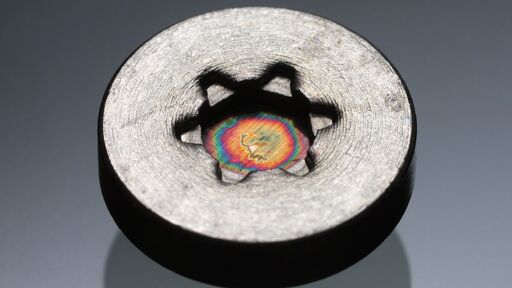
“The isotope of interest for space is americium-241…Its half-life is a staggering 432 years, five times longer than plutonium-238.”
isn’t this the same element found in older smoke detectors?
Yes.
Shout-out for The Radioactive Boy Scout. (RIP)
That it is!
With an atomic number of 241, it’s hardly small.
Yes. And also:
Its half-life is a staggering 432 years, five times longer than plutonium-238.
Cringe…
AI slop?
Cringe…
AI slop?
Plutonium-238’s half-life is 87.7 years, Americium-241 is 432.6 years. Which… is almost 5 times longer, so… not sure why that’s cringe?
With an atomic number of 241, it’s hardly small.
I believe they’re referring to the fact that it’s not an element of major topic. This is the first time I’ve ever heard of it.
I think this could be compelling given that tech continues to get more power efficient. I don’t know the numbers, but if we were to launch the same tech that’s on Voyager 1/2 today, would we be able to do that with 1/5 the power? If so, those probes could likely still have all their instruments running if they used Americium.
Plutonium-238’s half-life is 87.7 years, Americium-241 is 432.6 years. Which… is almost 5 times longer, so… not sure why that’s cringe?
What’s cringe is the word “staggering”. Natural radioactive isotopes have half-lives on the order of billions of years. All elements heavier than iron are created in supernovae. Billions of years have passed since the novae that created that heavy elements now on earth. Anything with shorter half-lives is no longer around. (More correctly, one should talk decay chains.)
What’s staggering is that these isotopes are available at all. They are artificially created in nuclear reactors. Mass production of Pl-238 began only during WW2 for bombs. That’s almost a half-life ago. The shorter half-life makes the availability of Pl-238 much more impressive.
I believe they’re referring to the fact that it’s not an element of major topic. This is the first time I’ve ever heard of it.
There are over 100 named elements. I don’t think I could name half of them. Americium is relatively prominent because of it’s use in smoke detectors. And while I’m at it: Americium is the element. Americium-241 is a specific isotope; a specific variant, chemically identical to other variants but with slightly different physical properties.
There are a number of isotopes suitable for RTGs. It’s a matter of trade-offs. There’s half-life, which is basically how fast the properties of the material change. There’s also energy density and how bad the radiation is for the device. And always, there’s cost. Fun fact, in Chernobyl they did try robots, but the electronics could not withstand the radiation. People don’t withstand it either, but there’s a lot of them.
It also costs about 10 times as much as gold. Still actually cheaper than Pu-238 though but hard to put a price on Pu since it isn’t for sale.
As an alpha emitter it is as dangerous as Polonium but it doesn’t dissolve in water. It is easily shielded but if it gets in your body it causes lots of damage, similar to Plutonium.
10 times as much as gold
To -make-, yep. As the article pointed out, there’s a lot of Amercium in waste dumps where old smoke detectors … and anyone can make it. Five times the half-life means it can power much longer missions.
I like to recover old smoke detectors and eat the americium. I’m well on my way to becoming captain americium.
Seems kinda dangerous to do radioactive materials scrapping, but if you got the safety protocols and equipment worked out then it’s a living
longer missions
The length of missions is not currently and will not in the short or medium term be limited by the lifespan of plutonium.
Except in regions where there is no access to Pu … as the article itself pointed out.