

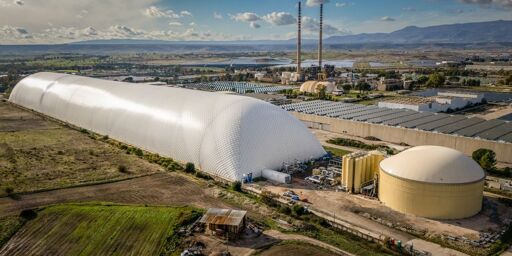
"This giant bubble on the island of Sardinia holds 2,000 tonnes of carbon dioxide. But the gas wasn’t captured from factory emissions, nor was it pulled from the air. It came from a gas supplier… “The facility compresses and expands CO2 daily in its closed system, turning a turbine that generates 200 megawatt-hours of electricity, or 20 MW over 10 hours.”
I run a consulting practice around flexibility. Been around the energy space for 15 years. Boy if I had a dollar for every time I’ve heard “grid scale [x] will soon be everywhere”
Stockholders and aalesmen make them put that towards the end… to make investors feel dizzy I think
Eh, HRSG’s got real popular in the 90s and now most major plants have them. Its not a rapidly changing space, dont get me wrong. But new shit comes around every so often.
Sure wish they mentioned the effeciency.
Could be very high, even the waste heat from the compression could be used to achieve more compression and turbines get to above 90%, that all depends on the scales they’re building this at. 70% overall doesn’t seem unrealistic as an educated guess.
even the waste heat from the compression could be used to achieve more compression
No. Waste heat (which is always low-temperature in respect to the device in question) can by definition not be converted to mechanical work. (Edit: to uninformed people downvoting this, this is nothing else than Carnot’s law in action.)
Otherwise, one could build a perpetuum mobile: Convert heat to mechanical work, use that work to generate heat, convert it to work again, and so on. You’d have a machine that generates energy out of nothing, and that’s not possible because of the law of energy conservation.
Damned good question, and I played stump-the-search-engine for 15 minutes and it’s like they’re AVOIDING that question
Sure wish they mentioned the effeciency.
Without it you should dismiss the whole article as worthless garbage
deleted by creator
On the downside, Energy Dome’s facility takes up about twice as much land as a comparable capacity lithium-ion battery would. And the domes themselves, which are about the height of a sports stadium at their apex, and longer, might stand out on a landscape and draw some NIMBY pushback.
This is surprisingly good! I would have figured it would have taken far more than twice the land than a Lithium battery solution.

It came from a gas supplier…
Where do you think supplier got it from?
Also: WHERE ARE THE ROUNDTRIP EFFICIENCY NUMBERS???
This CO2 is acting as a reusable fluid in a closed loop. The initial capture of the CO2 costs energy, but the battery keeps using the same CO2 over and over again. So the question of efficiency should be more about land usage and maintenance of the rest of the parts and the labor needed for each megawatt stored vs what other grid scale energy storage costs in materials and labor.
The rough reality is that batteries aren’t going to be up to the task of grid scale energy storage unless they have a couple huge breakthroughs. Something like this is a far less materially expensive way to store energy for later use.
Currently most grid scale energy storage is just pumping water up a hill and letting it back down through a generator. It is extremely limited in where it can be used and requires tremendous space to be effective.
This concept was started 3-5 years ago, when retail batteries where $500/kwh. They are now under $100/kwh. Concept is worthwhile for diversification of resources and talent.
There’s not enough minable copper or lithium to make all of the batteries we will need. So e alternatives will have to emerge if we are to reduce the need for generating power on demand with fuels.
Compressing gas generates heat, and a significant part of that heat will be lost. Heat dissipation is irreversible, and this lowers efficiency a lot.
BTW the same reason why in industry, pneumatic drives are universally replaced by electric motors: Their efficiency is too low.
deleted by creator
We had these things called Gasometers in the UK for a long time. They expanded with the amount of gas stored in them, and they kept the pressure of the local gas supply up. A local gas reservoir, or “gas battery” if you like.
These bubbles are basically the same idea but at higher pressure.
I wonder how resilient they are to big winds.
160km/hr as per TFA.
Guilty, I only skimmed it. Thanks.
And if there is a known high wind coming, the plant can forcefully go through the compression cycle to remove the bubble.
That’s really not that big of a wind. One bad storm and we have it burst
Also, per the article, the danger zone in a burst is only claimed to be 70m until cleared and the CO2 release still pales in comparison to a regular coal plant - “equivalent to 15 round trips between New York and London on a Boeing 777”
The article also mentions that they can deflate it in around 10 hours
I imagine that the bubble portion is light weight enough, one could put it on the roof of a data center, apartment building, strip mall, etc. That appears to be the piece that takes up the most space.
Another thought. I wonder if the bubble portion could be oriented vertically, maybe inside a simple enclosure to protect it from wind.
I was thinking about much larger scale bubbles in “unwanted” geological depressions such as old open pit mines or rock quarries. The depression in the ground might offer more protection allowing it to scale up higher in volume.
Sounds pretty good
Wonder how small you can scale these and retain efficiency, at twice the footprint (but I’m guessing a lot more volume) of a lithium grid battery, will we see these replacing home batteries down the line?
They are talking hectares in this and it looks like the power density is below that of batteries, but its also cheaper per MWh.
I home long term battery makes a lot of sense, I have thought for a while something that goes from water and the air into methane or even liquid fuel would be highly beneficial as it could run from a generators through the winter and act for long term storage without requiring a turbine.
The tanks might go underground mitigating (perhaps) the pressure explosion risk as opposed to lithium fire risk, but the honking great tent is an issue. Should have a longer life than Li Ion and be repairable vs somewhat recyclable. At scaled production it could certainly be cheaper, but some of the newer immobile battery chemistries might beat it. Synthesized fuel also makes a lot of sense. We shall see. What certainly makes sense is microgrids and power self-sufficiency.